
The rules we strap to
Securing a load
How a load is made safe, in the order it meets the rules. All of it rests on the DVSA code of practice, Securing loads on HGVs and goods vehicles, last updated on 24 September 2026, and on the British Standards it cites.
Three people answer for it
The operator
Runs the vehicle and is answerable for how its loads are planned and secured, every day it is on the road.
The driver
Takes the vehicle on the road, checks the load before setting off and again on the way, and stops if it moves.
The consignor
Packs and often loads the goods. The weight given and the way a pallet is wrapped decide what holds it.
The code puts the duty on all three at once, so a load that shifts is never one person's mistake, and the questions in an enquiry are not idle ones.
The three forces
Whatever holds a load has to withstand the entire weight of the load forward, half of it to either side and half to the rear. Forward is the largest because braking is the hardest thing a vehicle does to its load. These figures are why a strap count is worked out and never guessed; the calculator on the first page works them for any mass you type.
Friction, counted honestly
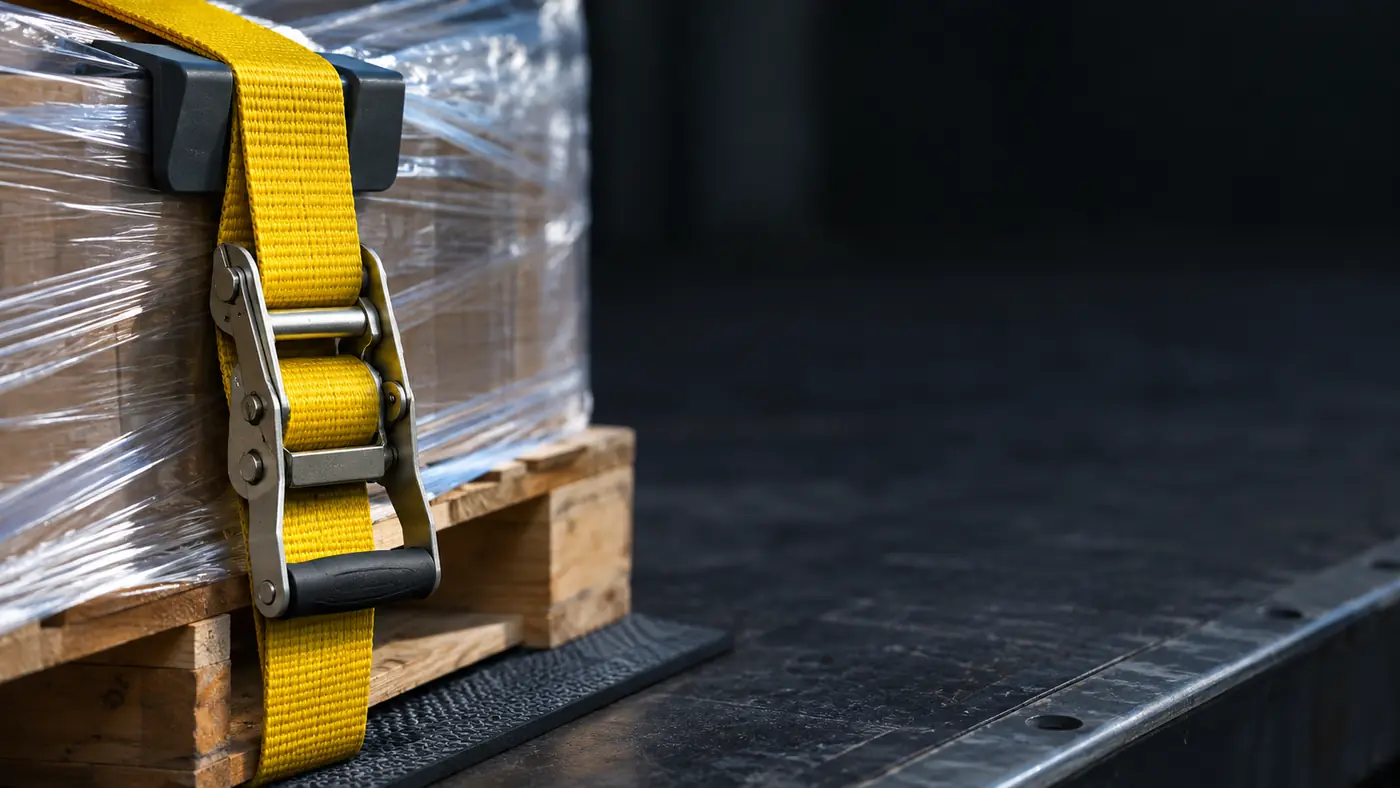
Unless there is a certified coefficient for a high-friction surface, the figure to assume between load and deck is 0.2. An anti-slip mat raises it, and only the value on the mat maker's certificate may be counted. The code puts it in one line we repeat to anyone loading with us: you cannot rely on the weight of a load alone.
Blocking first, then lashing
Blocking
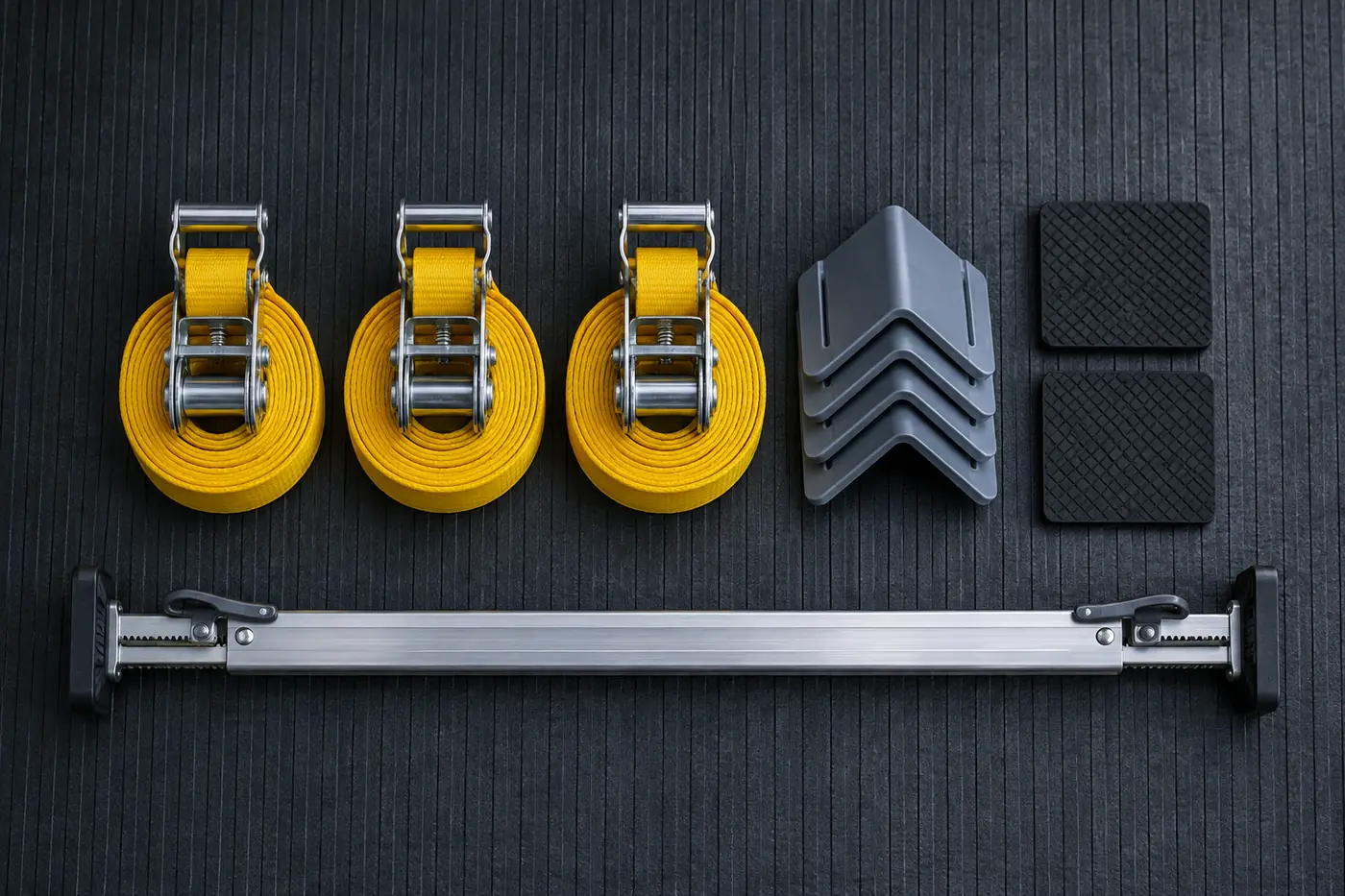
The simplest restraint is a load with nowhere to go. Goods go hard against the headboard; gaps between pallets are closed or filled with dunnage; a load bar across the body holds back a part load that cannot reach the front. Blocking takes force without tension, which is why it comes first, and why a headboard is only counted up to what its documents say it was built for.
Top-over lashing
Straps over the top press the load onto the deck and the extra friction holds it. The steeper the strap, the harder it presses, so the angle matters; the figure that counts is the strap's standard tension force, the STF, in daN.
Direct lashing
Straps or chains run from the load to lashing points and hold it directly. Here the lashing capacity, the LC, counts, and the lashing points must be rated for the job.
Reading a strap, and retiring one
Every strap carries a label with its lashing capacity, its standard tension force, its length and its material. A strap whose label cannot be read cannot be trusted with a load, because nobody knows what it was made to hold. Straps come out of service when they are cut, frayed, burnt or stiff with damage, or when the ratchet will not hold its tension, and they are checked as they are rolled at the end of every delivery.
Bodies: standard and XL
On a standard curtainsider the curtain is weather protection, and anything attached to the frame, such as the buckle straps or an internal net, secures 400 kg at most. An XL body is built to BS EN 12642, marked XL and documented, so its sides can take part of the force as the certificate states. Fitting XL-rated curtains to a standard body does not make it an XL body.
After the first few miles, and after every drop on a multi-drop round, the load is looked at again and strapped again wherever something has moved or a gap has opened.
The standards the code cites
- BS EN 12195-1 the calculation of securing forces; -2 web lashings; -3 lashing chains
- BS EN 12640 lashing points on goods vehicles
- BS EN 12641-1, -2 tarpaulins and curtainsiders
- BS EN 12642 the strength of the body structure
- BS 7121-4 the safe use of lorry loaders